
ENDURE Engages Recreational Divers in Aarhus as Part of Its Soft Data Work

This past weekend, ENDURE participated in the Danish Sports Diving Association’s (DSF) Marine Archaeological Committee’s (MAU) marine archaeology course in Aarhus, Denmark, which focused on citizen science in a maritime archaeological context. The course brought together recreational divers, aspiring marine archaeologists, and professionals around questions of underwater cultural heritage, public participation, and the role divers can play in supporting archaeological work beneath the sea surface.

For ENDURE, attending the course was important for a specific reason. As the project moves into a new phase of its Work Package 3, we are beginning to collect what we refer to as soft data: socio-cultural values and perceptions that different groups in society attach to underwater cultural heritage.
Soft data concerns how people understand, value, and relate to submerged cultural heritage. It is about asking what society sees as important, why certain places are considered meaningful, and how different users of the marine environment may value the same place in different ways. These perspectives matter because decisions about the sea and seabed do not take place in a vacuum. Instead, they involve multiple users, interests, and priorities, and trade-offs are often unavoidable.
Over the coming phase, ENDURE will begin gathering data on how selected stakeholder groups value and relate to underwater cultural heritage. The aim is to better understand these perspectives and integrate them into ENDURE’s broader modelling framework.
Seen in this light, the course was a valuable opportunity to begin engaging one of these stakeholder groups directly: recreational divers. Divers are not only users of the marine environment, but also people with strong interests in the heritage found there. By attending the course and presenting ENDURE’s work to this stakeholder group, we were able to introduce the project’s upcoming soft-data phase and invite interested divers to sign up as potential contributors. Although the actual data collection still lies ahead, the weekend marked an important beginning.
At the same time, the course also encouraged a broader reflection on the role of citizen science in the field of underwater archaeology. This is an area in which citizen science remains comparatively underexplored, despite its considerable potential.
Many heritage managers around the world lack the personnel and financial resources needed to regularly survey the seabed or revisit known sites, even though submerged sites are vulnerable to a range of threats, including environmental change and human interference. Recreational divers, by contrast, are often already present in these environments through their own activities. In this context, collaboration with recreational divers becomes especially important. They can act as the eyes in the water, noticing changes, reporting finds, and contributing valuable information on the condition of submerged cultural heritage.
This is not a new idea. Many scholars, including Goggin (1960) and Manders (2008) have noted, that divers have long served as the “eyes and ears” of archaeologists, and the early development of underwater archaeology was itself closely tied to the contributions of non-archaeologist divers. More recent initiatives, such as GIRT and Adopt a Wreck, have likewise shown how recreational divers can contribute to the recording, observation, and stewardship of underwater cultural heritage. In places where institutional capacity remains limited, that legacy remains highly relevant, as public participation can still play an important role in site discovery, monitoring, and thereby broader protection of underwater heritage.
Importantly, this is not a one-sided relationship. Citizen science can also offer something meaningful to the divers themselves. It can provide divers with a clearer sense of purpose, greater knowledge about the places they visit, and deepen their understanding of the cultural significance of underwater environments. Rather than moving through these landscapes without context, divers can feel part of a broader effort to document and care for the sites they encounter.
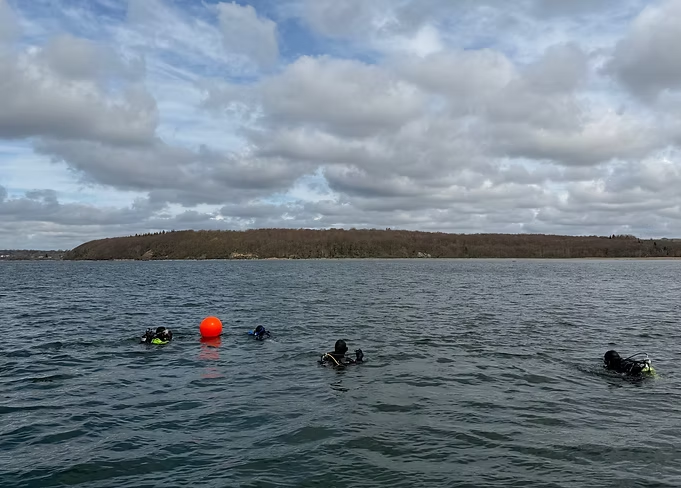
DSF and MAUS's course provided a strong example of this kind of cooperation in practice. During the course days, specially trained recreational divers took to the waters of Aarhus Bay, including areas around Begtrup Vig and Kalø Vig, to help Moesgaard Museum’s project SUBNORDICA search for traces of Stone Age settlements on the seabed. The divers made some finds, including stone tools and bones, but equally important were the observations made in areas where no finds appeared. These results can help SUBNORDICA narrow down which locations may warrant further investigation and which areas are less likely to do so. The course highlighted the value of working with divers who are not only active in the marine environment but also trained in underwater archaeological documentation and aware of the rights and responsibilities connected to underwater finds. National television coverage of the event also highlighted the broader relevance and public interest of this kind of cooperation.
Citizen science is therefore worth taking seriously in underwater archaeology, not only as a practical response to limited resources, but also as a way of building stronger connections between the public and cultural heritage. If carefully designed, such collaborations can improve reporting and monitoring while also fostering a stronger sense of shared responsibility for the protection of submerged cultural heritage. In this sense, initiatives of this kind can also strengthen ocean literacy, which UNESCO promotes as part of the Ocean Decade’s wider ambition to build the science, understanding, and engagement needed for the ocean we want.
Therefore, while ENDURE attended the course with a specific purpose related to the project’s upcoming soft-data phase, the weekend also offered a valuable reminder of the broader potential of citizen science in the field of underwater archaeology. Beyond helping us make initial contact with a relevant stakeholder group, it demonstrated how collaboration with recreational divers can contribute to reporting, monitoring, and public stewardship in meaningful ways. As the project moves forward, encounters like this highlight that sustainable heritage management depends not only on environmental and archaeological data, but also on the values, observations, and engagements of the people who interact with the sea.
Would you like to contribute to ENDURE’s upcoming soft-data phase?
We welcome expressions of interest from recreational divers and other maritime stakeholders who would like to share their perspectives on underwater cultural heritage. You can sign up here: https://forms.gle/x7YfvbYcxA7MYqfA7
References:
Goggin, J.M., 1960. Underwater archaeology: Its nature and limitations. American Antiquity, 25(3), pp. 348–354.
Manders, M., 2008. In situ preservation: ‘The preferred option’. Museum International, 60(4), pp. 31–41.


The engagement with recreational divers was interesting because it shows how citizen participation can contribute to scientific research. I once took part in a small data collection activity during college, and it made research feel more hands-on and meaningful. At that time, I also searched for aleks chemistry course completion while balancing lab work and assignments. Public involvement can greatly enhance scientific understanding.
It was great to read about divers helping collect information for marine research in Aarhus. Projects that involve local communities often create stronger connections to science and conservation. During a marine studies assignment, I searched for help with online class materials to understand similar citizen science programs. Small contributions from many people can make a big difference over time.